
Green Revolution 2: How Drones are Re-shaping the Farming & Positioning India as Top Food Exporter
Just imagine, you wake up in the morning as a farmer and start exploring apps on your smartphone. Apps, informing you about the soil health of your farming lands, predict the weather of your area, alerting any crop diseases before they harm and spread nutrients and pesticides on crops with modern technology enabled by phone in no time.
This seems like a scene in a Sci-Fi movie, right? Not anymore!
AI, Machine Learning, advanced tools and new technologies like Drones are providing great help to farmers in making smarter decisions, leading to more productivity with real-time data. Drones alone have changed the face of farming across the world.
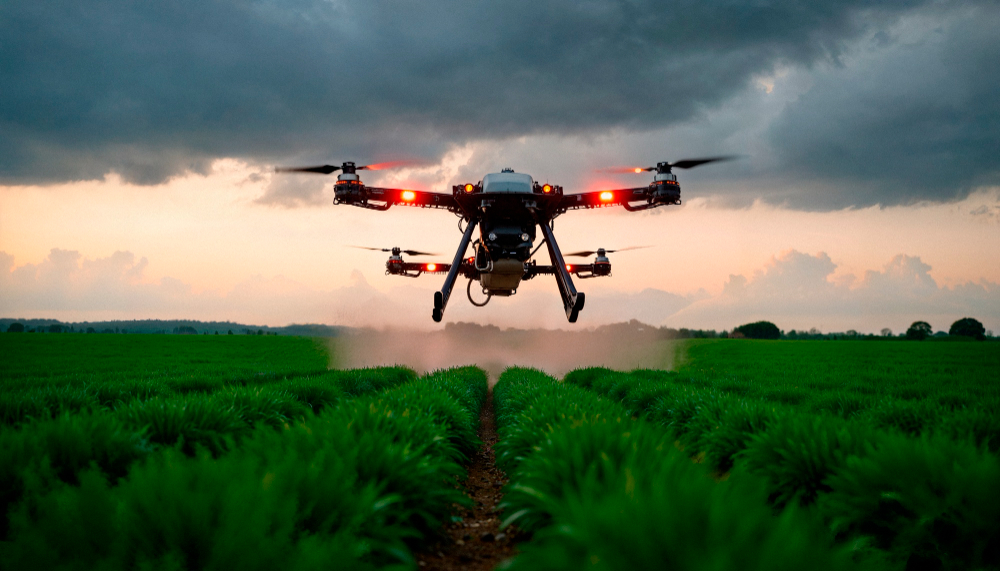
It has become a reality that you can have the sips of your morning tea at home and at the same time a flying robot carrying a payload of Pesticide, spraying over your farms and protecting your crops!
Drones are contributing significantly to the future of Indian agriculture. They are no longer a wedding photography device only. Drones are replacing traditional manual labor work for mapping farming lands, crop monitoring, detecting crop diseases, Pesticide spraying and even planting seeds.
What is a Drone Exactly?
A ‘Drone’ is an Unmanned Aerial Vehicle (UAV) or an Unmanned Aircraft System (UAS), operates without a human pilot on board. A drone can be flown and controlled remotely by an operator, mainly humans. These drones come in various sizes and types, designed for different roles.
These aircraft are equipped with cameras, sensors, and payloads for performing tasks as aerial surveillance, photography, and agricultural uses. Due to their versatile role, ability to reach in difficult areas compared than human pilots and cost effectiveness, drones are continuously gaining widespread popularity across the world.
The Road to Next Green Revolution
It took India 21 years to commence its first program on ‘Increasing food grains production’ in 1968 after its independence. Major milestones in this initiative were the development of high-yielding categories of wheat and rust-resistant strains of wheat.
This undertaking successfully achieved its target and was named as ‘Green Revolution of India’, which included the first-time introduction of high-yielding varieties (HYV) of seeds, improved quality of fertilizers, modern tools of farming and effective irrigation techniques into the traditional agriculture of India.
This Green Revolution of India, which reigned over the period from 1967-68 to 1977-78, transformed India’s status from a food-deficient country to a global leading agricultural nation.
A Game-changer Step After 42 years
After 4 decades, precisely 42 years later, India has initiated new revolutionary steps towards its agriculture and industry sectors. India has been developing a robust drone manufacturing ecosystem through new Drone rules and regulations. It was released on 25th August 2021 along with schemes such as the Production Linked Incentive (PLI).
These initiatives are gradually changing the face of modern Indian agriculture. Watching a drone efficiently spraying nutrients and pesticides over crops in the lands of a remote village significantly shows the power of new technologies.
Technologies that make Indian farming smarter, faster, and more productive. This is not about just improving the yield and quality of crops, but about saving valuable time, minimizing costs and making farming more sustainable.
Drone in Agriculture – A Govt. Initiative
The Indian government has been actively promoting drone use in defense, logistics and especially in agriculture since 2021. The government is sincerely backing up this drive by introducing policies like the ‘National Drone Policy and Drone Rules 2021’ and the ‘Kisan Drone Schemes’. These initiatives offer Indian farmers and entrepreneurs financial aid for drone purchase and adoption.
Federation of Indian Chambers of Commerce and Industry FICCI-EY has published a report on the drone industry. According to this report, the drone industry in India is estimated to contribute 50 billion USD to manufacturing potential by 2030. This will generate over 5 lakh jobs in the country.
The agriculture sector is going to be a prominent driver, with a projected market size of 885.7 million USD by 2030.
125 Crore Funds for Promotion & Subsidy
The Indian government is progressively working for farmers to adopt new technologies as drones, in the agriculture sector. The Government has already issued approximately 125 crore INR for promoting drone technology, educating farmers on the benefits of drones and aiding them to use drones by providing subsidies.
52.50 Crores INR funds have been released to the Indian Council of Agricultural Research (ICAR) for implementing of large-scale demonstration of drone technology on the farmers’ lands across the country. This has been done through 100 Krishi Vigyan Kendras, 75 institutions under ICAR and 25 State Agricultural Universities.
There is another 70.88 Crores INR that has also been released to various State governments. So that these State governments demonstrate and provide subsidies to their farmers for adopting drone technology and the establishment the of Custom Hiring Centers for providing drone services to them.
100 Billion Global Market by 2030
Drones are significantly increasing their market reach across the world. No country in the world is untouched by this modern tool, whether it is for defense or for development in industry and agriculture. A study in recent days prepared by Bloomberg indicates that the worldwide drone industry is estimated to reach 100 billion USD by the year 2030.
According to the study, approximately 35%-40% growth in the drone market will be recorded from commercial and recreational drone usage. India will play a remarkable role in it. The Indian drone market size was estimated at 1.2 billion USD in 2023. For the period from 2024 to 2030, the Indian drone market size is projected to grow at a CAGR of 22.15%, reaching 4.87 billion USD by 2030.
Possible Benefits of Drones in Indian Agriculture
1- Crop Mapping
Drones can click high resolution photos and get data of the crops of Indian farming lands. Drones can provide valuable information on crop health, yield, and growth. These aerial devices can help to give real time data of soil quality, moisture and nutrient levels.
2- Pesticide Spraying
One of the most important use of Drones in agriculture is pesticide spraying. Drones can be used to spray nutrients, fertilizers, and pesticide on the crops with a more precise and efficient way. This will help in reducing wastage of resources, and the exposures of labor o farmer to harmful chemicals.
3- Monitoring of Crops
Drone technology can be broadly used in monitoring the crops throughout the whole growing season. By adopting drone, it can provide farmers real-time data, feedbacks and alerts on pest infestations, diseases and crop damage. This will help farmers to detect these dangers and protect their crops with improved quality and quantity.
4- Transportation of Crops
Another great benefit of drones is they can be used as a goods transporter. Drone can transport crops from the farms to the government storage or markets in a smooth and fast way. Drones can also be used to transport seeds, saplings, tools and other important things to the farming lands, and minimizing dependency on poor road conditions and infrastructure.
India as Leading Agricultural Products Exporter
After the Green Revolution period during 1968-1978, India emerged as a leading agricultural products from a food grains importer. Introduction of drone technology will transform the face of Indian agriculture even further.
These drones can effectively spray nutrients and pesticides across 3 to 12 acres of land within an hour. This promise a high increase in crop productivity, high yield, and crop protection with reduced labor and time.
At present, India is the 8th largest exporter of food grains and agricultural products globally, accounting for a 2.5% share of worldwide agricultural export in FY 2023-2024.
According to the Union Ministry of Commerce, India’s agricultural exports have significantly risen by 6.47% reaching 51.91 billion USD in FY 2024-2025. In FY 2024, the export of India's agricultural products was at 48.15 billion USD. Whereas in FY 2023, the agricultural export from India was higher than in FY 2024 & 2025, i.e., at 52.50 billion USD.
Rice is the most produced crop in India, even larger than wheat. This is why rice is the largest exported agricultural product from India. Rice remarkably contributes more than 20% of the total agricultural exports.
UP- The Dream of Being Global Leader via Drone
Uttar Pradesh, one of India’s largest agricultural producers, aims to modernize its agriculture and provide economic benefits to its farmers by adopting efficient tools and technologies. Agriculture remains the backbone of UP’s economy. A majority of the population of the state is dependent on agriculture.
Uttar Pradesh is aiming to position itself as India’s top agricultural state by 2030. With the roadmap of ‘VIKSIT UP @ 2047’, the state is focusing on sustainability, innovation, and modernization to transform the ecosystem of traditional farming and boost exports. So that matches its ability to produce with global giants like Mexico, the US, China and France by 2047.
To gain the top position in agricultural exports in India by 2030 and become a leading global exporter like Russia, Canada and Australia, the UP government has launched 9 drone-based crop protection pilot projects across six districts. Two each in Gorakhpur, Bahraich, and Muzaffar Nagar, and one each in Lucknow, Ghaziabad, and Kanpur Nagar.
Governments Programs Supporting in Agricultural Drone
The Indian government, along with many state governments, has launched various subsidy programs. So that even small-scale farmers, cooperatives and Agri-entrepreneurs can access and afford the drone technology in their farming. The top 3 subsidy schemes are here:
1- Agriculture Infrastructure Fund (AIF)
This fund is launched by the Ministry of Agriculture and Farmers Welfare. This fund provides financial help for establishing farm infrastructure and provides a loan with a subsidy for to purchase of drones.
2- Ministry of Civil Aviation
The Ministry of Civil Aviation and the Ministry of Agriculture have collaborated to introduce up to 50% subsidies, especially for agricultural drones used for spraying pesticides and fertilizers.
3- State Governments' Subsidy Programs
Various State governments, including Maharashtra, Karnataka, and Telangana, have declared their own state subsidy schemes to promote the use of drone technology in agriculture. The Uttar Pradesh government has also initiated ‘Atmanirbhar Krishak Samanvit Vikas Yojna' to provide a subsidy and a loan for drone purchasing.